A question of quantity
In recognized cases of lactose intolerance, objective studies conducted under medical supervision show that individuals with a lactase deficiency (the enzyme which breaks down lactose) can digest up to 7 g of lactose in one sitting.
7 g of lactose is equivalent to a 150 ml glass of milk or one portion of dairy, according to the guidelines of the Programme National Nutrition Santé (French national program for nutrition and health) (PNNS1).

A question of quality
Many dairy products barely contain any lactose at all, as is the case with aged cheeses. In addition, the enzymes present in yogurts help with the digestion of lactose.
Average lactose composition of various dairy products (per 100 g):
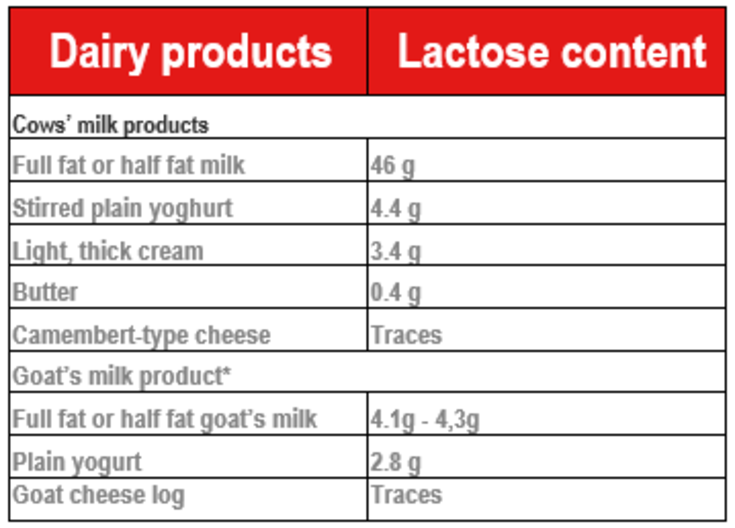
Taken from P. Marteau and S. Olivier. Lactose Intolerance. Cahiers de Nutrition et de Diététique (2017) 52S, S13–S18. *Supplementary data from the CIQUAL 2017 table.
When cheese is made, the lactic fermentation process enables most of the lactose to be removed when the cheese is drained. The small amount of remaining lactose is then pre-digested during the aging process by lactic acid bacteria. This is why cheeses only contain traces of lactose. It is important to realize that the “older” the cheese, the less lactose it contains2.

For yogurts and any other type of fermented milk such as stirred yogurt or fromage blanc made with goat milk, the lactic acid bacteria present digest the lactose once it reaches the intestine. It has been scientifically proven that the presence of these lactic acid bacteria improves the digestion of lactose in individuals who have trouble digesting it. This is why, even though it contains 2 to 4 g of lactose per oz, a cow milk or goat milk yogurt is well tolerated by people who 100 g have reduced lactase activity.

A question of pacing your consumption
Evenly distributing the amount of lactose you consume across different meals throughout the day will improve your tolerance. As a result, for people with a very low amount of lactase activity, it is better to consume smaller quantities of lactose in each sitting but spread them out over the course of the day.
To sum up, being lactose intolerant does come with some restrictions, but it is not the end of the world
In fact, it is 100% possible for people who are lactose intolerant to continue enjoying dairy products without suffering from unpleasant digestive symptoms, simply by choosing carefully from the many types of aged cheeses, yogurts, and any other type of fermented milks available. So, don’t deprive yourself any longer, it is time to rediscover the pleasure of cooking with dairy products. Time to get your recipes out!
[1] Launched in France in 2001, the PNNS is a public health plan that aims to improve the health of the population by acting on one of the most important factors, the nutritional : http://www.mangerbouger.fr/Les-9-reperes/Les-9-reperes-a-la-loupe/Produits-laitiers.
[2] « Allergie aux protéines de lait et intolérance au lactose », CNIEL, Question Sur, page 11.